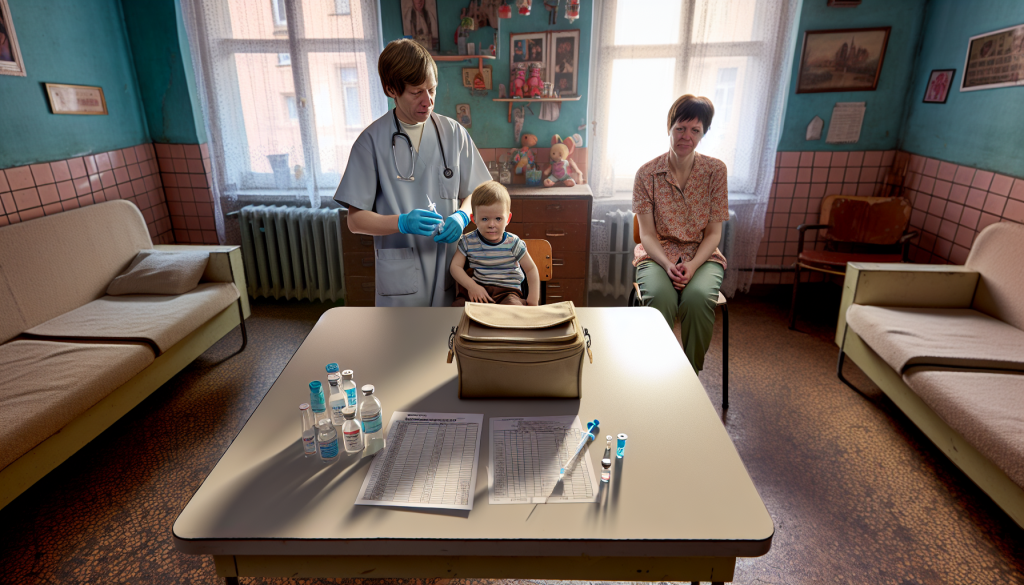
Photo source: AI generated image
Children from struggling families will be able to receive routine vaccinations at home in parts of England under a new £2m government pilot scheme, as immunisation coverage continues to fall short of levels needed to prevent outbreaks.
Under the programme, health visitors – specialist public health nurses who support families with children under five – will be able to administer vaccines during routine visits. The government said this is intended to remove “obstacles” that can stop some families accessing healthcare.
Who the pilot aims to reach
A government statement said the pilot will focus on families who have “fallen through the cracks”, including those not registered with a GP, and those facing travel costs, childcare pressures, language barriers or other difficult circumstances that can prevent them from getting to the doctor.
Ministers stressed the scheme is not meant to replace vaccinations given by GPs, and said families should continue to have their child vaccinated at their local surgery.
Where and when the schemes will run
The plan involves 12 pilot schemes, due to roll out from mid-January across London, the midlands, north-east England and Yorkshire, the north west and south west.
MMRV vaccine and chickenpox vaccination rollout
As part of the approach, eligible children will receive the new MMRV vaccine, which protects against measles, mumps, rubella and chickenpox, replacing the current MMR vaccine.
The government also said that from 2 January, all children will be vaccinated against chickenpox for the first time. A year-long trial is set to be evaluated ahead of a potential nationwide rollout from 2027.
Wes Streeting: “meeting families where they are”
Health Secretary Wes Streeting said: “Every parent deserves the chance to protect their child from preventable diseases, but some families have a lot going on and that can mean they miss out.”
He added that health visitors are “already trusted faces in communities across the country” and that enabling them to offer vaccinations would use existing relationships and expertise to reach families who need the most support. He said tackling health inequalities was central to “fixing the NHS”, and argued that meeting families where they are can help boost vaccination rates while building “a health service that works for everyone.”
How families will be identified and staff prepared
Health visitors involved in the pilot will receive additional training, including how to manage discussions with parents who may be reluctant to vaccinate their child.
Struggling families will be identified by the NHS using GP records, health visitor notes and local databases.
Falling coverage and regional gaps
The pilot comes as immunisation rates remain below targets recommended to prevent diseases spreading among children. Figures released last year showed not a single childhood vaccine in England in 2024 met the 95% target needed to ensure diseases cannot spread among youngsters.
Data released in August 2025 showed sharp regional differences in uptake continue, with health officials warning last year that almost one in five children would be starting primary school without full protection against a number of serious diseases.
The World Health Organisation (WHO) recommends at least 95% of children should receive vaccine doses for each illness to achieve herd immunity, but none of the main childhood vaccines in England reached this level in 2024/25.
Latest MMR and other vaccine uptake figures
According to the UK Health Security Agency, 91.9% of five-year-olds had received one dose of the MMR (measles, mumps & rubella) vaccine. This was unchanged from 2023/24 and the lowest level since 2010/11.
Just 83.7% of five-year-olds had received both MMR doses, down from 83.9% year-on-year and the lowest level since 2009/10.
Uptake of the first MMR dose at 24 months stood at 88.9% in 2024/25, unchanged from the previous year but again the lowest figure since 2009/10.
Coverage for the Hib/MenC vaccine, which protects against haemophilus influenzae type B and meningitis C, was 88.9% for children in England aged five, down from 89.4% in 2023/24 and the lowest level since 2011/12.
Uptake of the four-in-one pre-school booster vaccine – which protects against polio, whooping cough, tetanus and diphtheria – stood at 81.4% among five-year-olds in England in 2024/25.
Readers can also follow updates via Tap here to follow.
Other health coverage includes: Hospitals are using AI to slash A&E wait times, The children and families spending a ‘different’ Christmas in hospital, and What are nicotine pouches and are they safer than smoking?.
More information about Sky News policies and standards is available at Why you can trust Sky News, and the Sky News app can be downloaded at Install the Sky News app for free.