
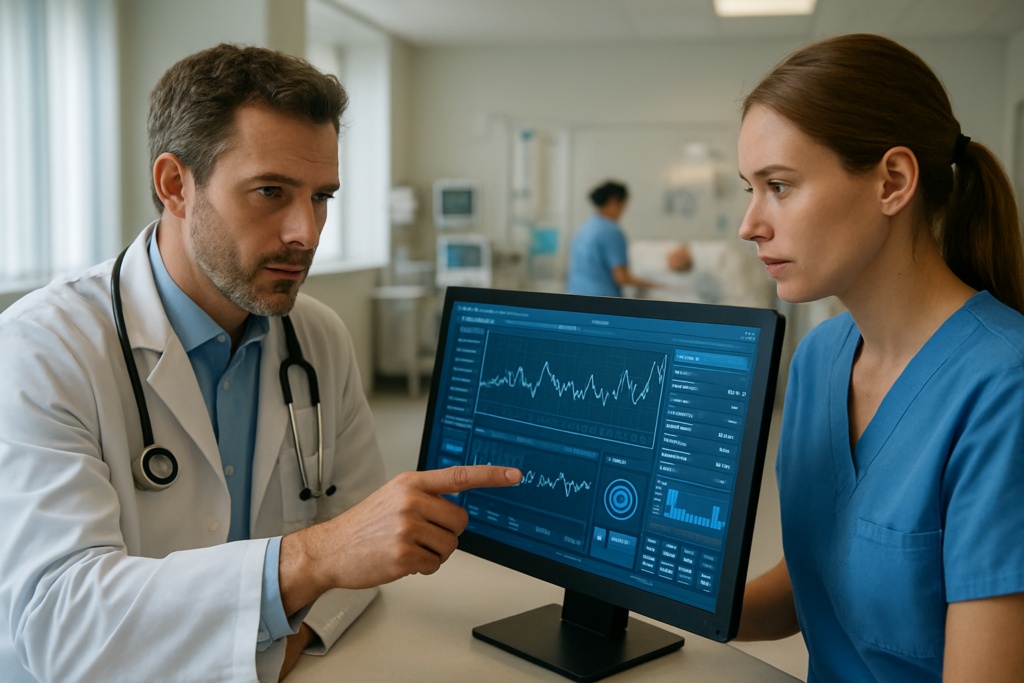
New research published on 2 September 2026 suggests artificial intelligence could help hospitals identify patient deterioration sooner by continuously scanning electronic health records for early safety signals. The work, published in npj Health Systems, argues that a background layer of AI monitoring could shorten the time between an event and its detection from weeks to hours or days.
Continuous monitoring could change how hospitals spot risk
The authors describe a model of “continuous clinical quality observability” in which AI agents read the narrative parts of electronic health records without interrupting clinical workflows. Their aim is to surface emerging safety concerns earlier than methods that rely on self-reporting, manual abstraction, or billing codes. The study says this approach may reduce manual case-finding and accelerate learning in high-reliability care settings.
That idea arrives at a time when health systems are under pressure to improve oversight while limiting staff burden. The paper does not claim the method is ready for routine deployment, but it presents the framework as a way to make quality monitoring more timely and less dependent on retrospective review.
Parallel work highlights the push to bring AI into medical practice
The same day, another Nature publication reported on a novel use of AI for predicting clinical deterioration in a post-acute hospital, underscoring the wider momentum behind algorithmic tools in healthcare. Together, the studies reflect a broader shift toward using machine learning not only for diagnosis, but also for operational surveillance and patient safety monitoring.
In the UK, the debate around digital health is especially relevant as the NHS continues to explore ways to improve early warning systems, reduce delays, and support overstretched clinical teams. The new Nature commentary adds to that conversation by framing AI as a potential layer of continuous oversight rather than a replacement for clinicians.
What the research does and does not show
The article emphasizes a concept rather than a finished product. It suggests that AI could help identify complications sooner, but it does not provide evidence that the approach has already been proven in routine hospital use. For now, the central message is one of promise paired with caution: earlier detection could improve safety, but hospitals would still need robust validation, governance, and oversight before such systems could be trusted at scale.
As health services weigh the benefits and risks of automation, the study adds a timely reminder that the most valuable role for AI may be as a support tool, helping clinicians notice problems earlier while human judgment remains in charge of care decisions.
Photo source: AI-generated or edited image